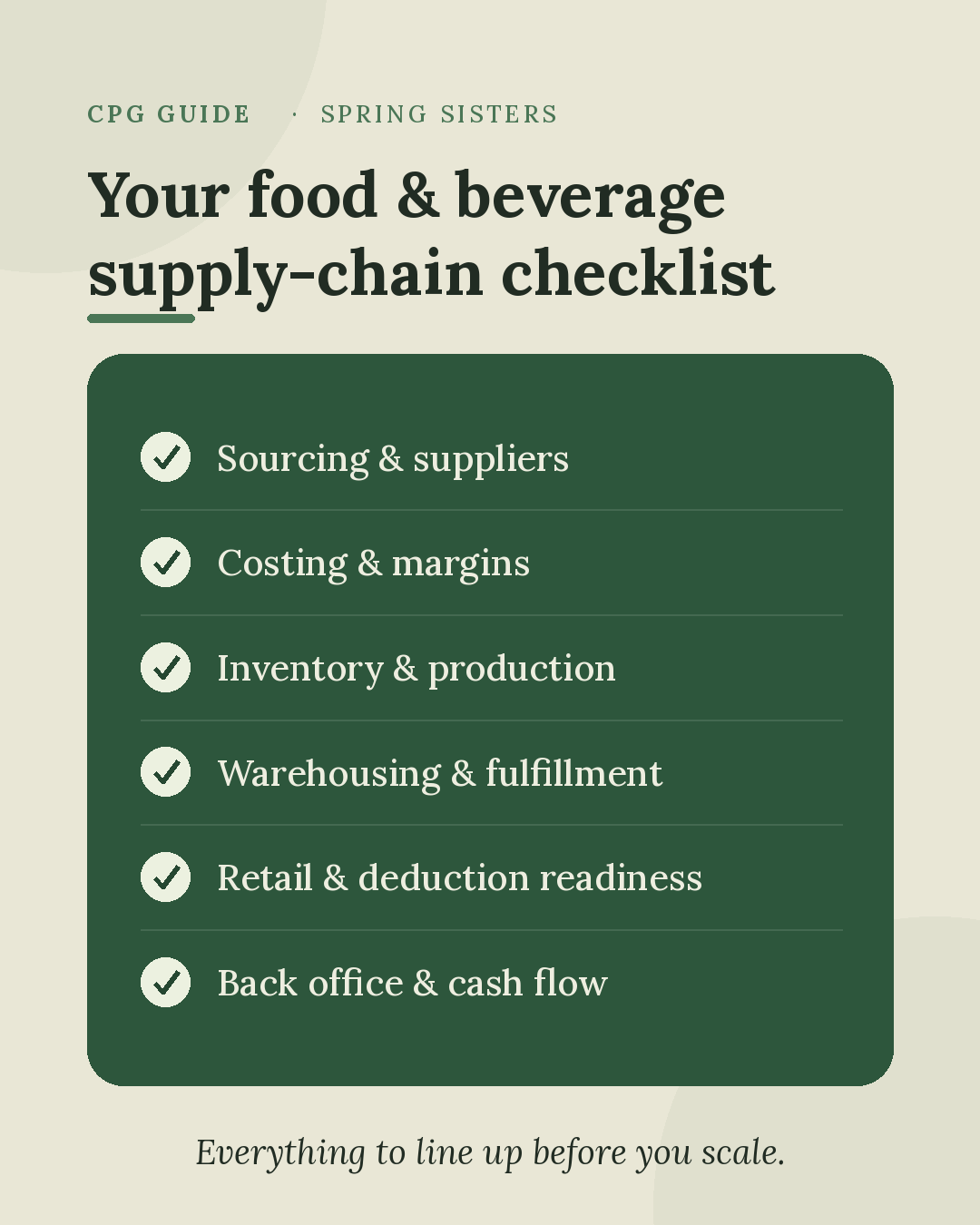
Launching a food or beverage brand is exciting — right up until the first big purchase order lands and you realize how much has to happen behind the scenes to actually fulfill it. The brands that scale smoothly are the ones that built their operational backbone early. Here is the supply-chain checklist we walk every emerging food & beverage brand through.
1. Sourcing & suppliers
- Identify a primary and a backup supplier for every key ingredient and packaging component.
- Document lead times, minimum order quantities (MOQs), and payment terms for each.
- Line up a co-packer or co-manufacturer before you need to scale — the good ones book out months ahead.
2. Costing & margins
- Calculate your true landed cost per unit: ingredients, packaging, freight, and co-pack fees.
- Set wholesale and retail pricing that survives retailer margins, promotions, and deductions.
- Revisit your costs every quarter — input prices rarely stay still.
3. Production & inventory planning
- Forecast demand conservatively for your first few production runs.
- Set safety-stock levels and reorder points so you never stock out on a hero SKU.
- Track shelf life, lot codes, and expiration dates from day one — non-negotiable for food.
4. Warehousing & fulfillment
- Choose a 3PL that can handle your temperature, compliance, and shelf-life needs.
- Map the difference between direct-to-consumer and retail/distributor fulfillment — they have very different requirements.
- Make sure you have real inventory visibility across every channel.
5. Retail & distributor readiness
- Learn the requirements for UNFI, KEHE, and direct retail: EDI, routing guides, and case-pack specs.
- Budget for slotting fees, promotional spend, and the deductions that come with distribution.
- Build a process to track and dispute retailer deductions before they pile up.
6. Compliance & documentation
- FDA facility registration, accurate labeling, allergen statements, and nutrition panels.
- Product-liability insurance, plus any certifications you claim (organic, non-GMO, kosher).
- Keep certificates of analysis (COAs) and supplier documentation organized and accessible.
7. Back office & cash flow
- Bookkeeping that tracks cost of goods sold (COGS) accurately, not just revenue.
- Cash-flow planning built for an inventory-heavy business — your money is tied up in stock.
- Systems or partners for deduction management and reconciliation.
You don’t have to build all of this in-house
Most founders are experts in their product, not in 3PL contracts or EDI routing guides — and hiring a full operations team before you have the revenue to support it is risky. That is exactly the gap Spring Sisters fills. We act as the fractional supply-chain and operations team for emerging food & beverage brands, so you can focus on growing the brand while we keep the back end running.
Get in touch and we’ll help you work through the checklist for your brand.